Next stop: Takamatsu, very close to Naoshima, where we’ve already been, but this time on the other side of the Seto Inland Sea.
Instead of coming up with their own mascot, Takamatsu seemed to have borrowed one from Pokémon, choosing Slowpoke. An interesting choice, going for a sleepy, dopey creature as their resident Pokémon, but hey, we can’t always try to understand the Japanese way of thinking, and it is pretty cute.
Apart from wandering around the city, we also used Takamatsu as a base for another road trip to venture onto the narrow roads leading into Shikoku’s nature. The region is famous for the Yoshino River, which runs through beautiful canyons. What better way to experience it than by going river rafting (Steve’s first time), including some cliff-jumping stops (not so fun for Steve). The water level was fairly low, so the rapids were manageable without capsizing our boat. This also meant our guide wasn’t shy about coming up with all sorts of quirky games designed to get us into the water. Unfortunately, no photos of all that fun, as we weren’t quite ready to sacrifice our still fairly new camera equipment.
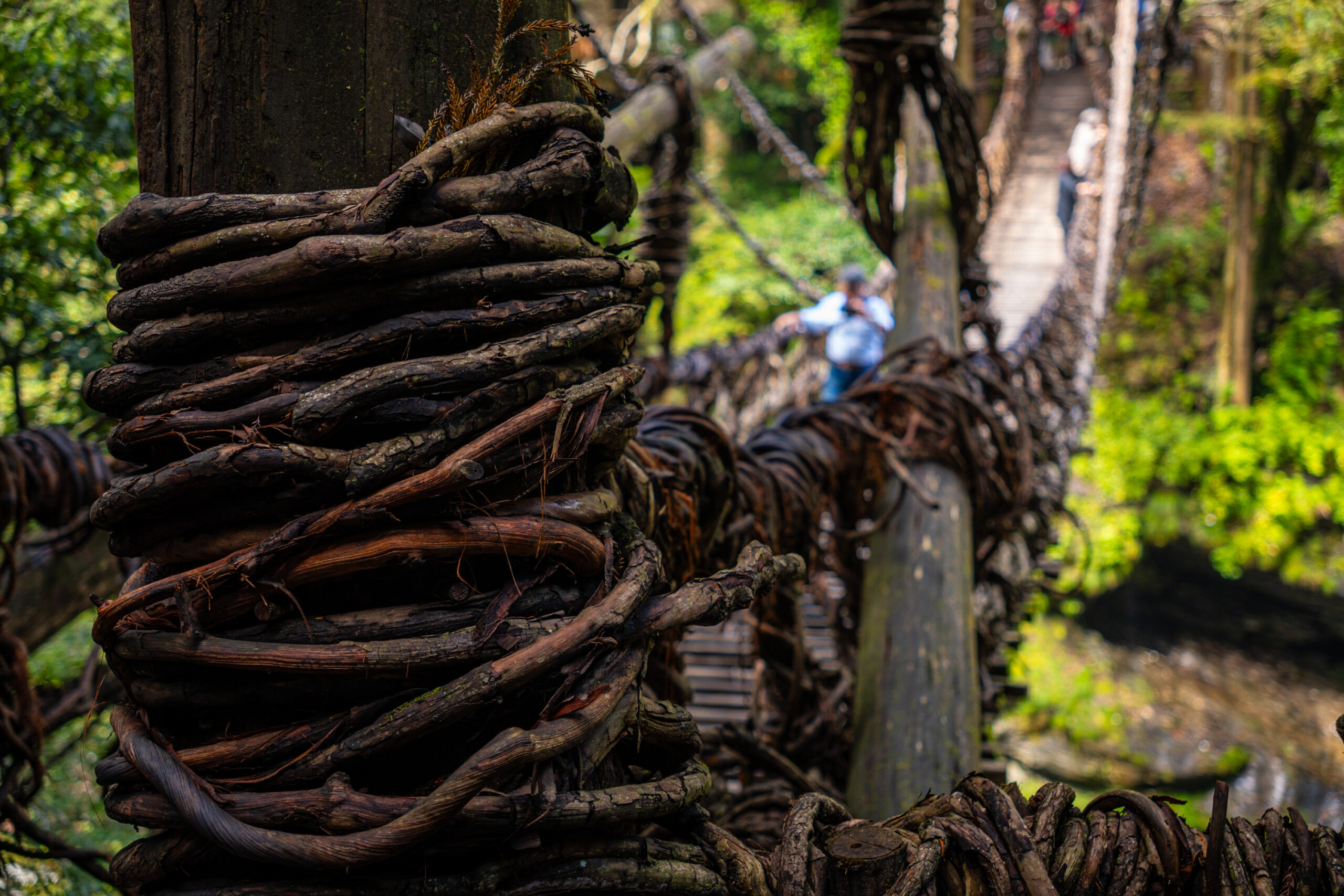
The mountains surrounding the area are also home to traditional kazurabashi, suspension bridges made from mountain vines. The wide gaps between the open slats give you a nice view of the blue water and rocks below, making for a pretty scary but iconic crossing (another great challenge for Steve’s vertigo. At this rate, he might be cured by the end of the trip).
The drive itself was also part of the journey, as usual. We were driving along winding roads built tens of metres above the gorge, past buildings standing on huge concrete stilts that just looked surreal. One word kept coming back to our minds: “raw”. The raw nature, decorated by raw man-made structures, with rusty iron beams left exposed and all.
On a completely unrelated topic, we’d like to talk a bit about the Japanese language and our journey with it (for all the non-language nerds, feel free to skip straight to the photos 🙃).
Given that this is our third time in Japan and we’re here for an extended period this time, we really wanted to make some progress with the language. For some context, Japanese uses three main writing systems. First, there’s Hiragana, a phonetic writing system used for grammatical endings, particles and many native Japanese words. The characters represent sounds, usually a vowel or a consonant followed by a vowel. For example, one character might be “to” (と). A full phrase like “thank you very much” is “Arigatou gozaimasu” (ありがとうございます).
However, apparently one writing system wasn’t enough, so there’s also Katakana, which represents the same sounds as Hiragana but uses different characters. It’s mainly used for foreign words, including many English loanwords. For example, “pizza” becomes “piza” (ピザ) in Japanese. You could technically write it in Hiragana too (ぴざ), but you won’t normally see that, since pizza isn’t originally a Japanese word.
But that’s not the end of the story. As two writing systems weren’t confusing enough, there’s a third one: Kanji. These are characters originally adopted from Chinese that carry meaning and are used to write many nouns, word stems and other parts of Japanese words. There are thousands of them, and learning them involves memorising their meanings and readings. By the end of compulsory education, Japanese students are expected to know around 2,100 commonly used kanji.
The cherry on top of all this is that written Japanese uses a colourful mix of all three. You can be halfway through a word or sentence that started in Katakana when, all of a sudden, there’s a Hiragana character followed by two Kanji. Good luck figuring that one out!
Now, where are we at with all of this? We’ve managed to get to a point where we can reliably read around 95% of Hiragana and Katakana. It’s not super easy, and there are still the occasional brain farts. Combined, the two systems have 92 basic characters, plus various modified versions, so there’s quite a bit to remember. Some are also comically close, like the katakana characters for shi, tsu, so, no and n (シ,ツ,ソ,ノ,ン). But being able to read both Katakana and Hiragana already gets you a long way. We can decipher most signs that don’t rely too heavily on Kanji, as well as quite a few menu items. A good example is the drinks section, which is often written almost entirely in Katakana.
As for Kanji, we’re slowly building up a very basic collection, mostly through common signs and by coming up with little memory tricks (the German word for which, “Eselsbrücken”, is much more fun). One example is the Kanji for station (駅), which is pretty useful in real life. We think of it as an R on the right (as in JR, the national railway company) with a train zooming up that R. Another fun part of learning Kanji is discovering the meanings behind the names of the places we visit. Often, the names are made up of characters whose meanings we can recognise, and the same characters appear in other place names. This creates some fun little chains. For example, we learned that Yamaguchi (山口), a fairly simple two-Kanji name, combines “yama” (山), meaning mountain, and “kuchi” (口), meaning mouth or opening (kind of makes sense when you look at it). Because of its meaning, that second character appears in signs for exits (出口) and entrances (入口), which are pretty much everywhere, including at stations. And since “yama” means mountain, we also recognise it in plenty of other place names, such as Okayama (岡山) and Matsuyama (松山). Matsuyama, in turn, shares the “matsu” character (松), meaning pine tree, with Takamatsu (高松).
We might be a bit nerdy, but we get pretty excited about these chains. Every time we discover a new connection, it gives us another little trick to remember a Kanji.
Of course, all of the above is only half the story. Just because you can read something doesn’t mean you understand what you’re reading. The many English-sounding words help, but they only get you so far. Conversations are still genuinely hard for us at this stage. We’re getting better at recognising the occasional word and are slowly starting to understand the general intent of a sentence (Japanese has its own logic when it comes to sentence structure, which is a fascinating topic but a story for another day).
We’re now at a stage where we can get in and out of a restaurant without a word of English. We’ve even managed to get through a couple of Japanese only check-in processes. A lot of pointing is still involved, and the fact that we’ve checked into 30+ hotels over the last two months probably helps us recognise what’s going on.
Anyways, we’re a long way from being able to hold a proper conversation. We probably won’t get there before the end of our trip… but we’ll do our best, one step at a time.



- Country
- Japan
- Region
- Takamatsu
- Date
- 20 October 2026
- Camera
- Sony a6700
- GPS
- 34.347965,134.045869

Jeej for the language stories! Are you considering doing language classes?
Considering it! 😅